
Welded Rims in Record Time
Grotnes
A steel rim in five steps
The development of machines that produce complex formed metal components while at the same time maintaining maximum productivity and profi tability was and is the declared goal of the company Grotnes (previously Fontijne Grotnes BV) throughout its more than 100 year history. The company is located in the Netherlands, in Vlaardingen near Rotterdam, and with its approximately 140 employees develops and produces – amongst other things – customer-specific machinery to produce steel wheel rims, and is one of the leading companies in Europe in this field. However, increasing demands placed on the load capacity of the produced parts in the automotive area especially call for ever-narrower manufacturing tolerances and reproducible high quality.
In order to meet these demands, the engineers at Fontijne Grotnes use comprehensive simulations to verify and optimize the production process long before their machines are constructed. Using "M-Target for Simulink" and the Bachmann automation system in their newest generation of wheel rim welding machines, the development time was slashed and a performance unknown up to now was achieved.
The range of the rim production machinery of Fontijne Grotnes goes from fully- and partially- automated machines to produce very narrow rims for car spare wheels to rims of substantial size for lorries. With a production capacity of up to 1,000 rims per hour raw material crosssections from 350 mm2 up to 3,000 mm2 must be processed on the machine.
In the first step of the production process, the steel raw material is uncoiled from the large coils it is delivered on and cut to size (cut-tolength line). The cylindrical hollow forms are shaped out of these pre-cut parts (preparation line). In the line that follows, the blanks are flared, profiled and expanded to the required circumference and brought into their final shape (profiling line).
The final product i.e. the steel wheel rim is already recognisable. When assembling in the assembly line, the leak tightness of the rim is checked, the hole for the valve is punched and the mounting disc is fitted and MIG-welded. Finally the rims are stove-enamelled.

Great expertise lies in the preparation of the blanks
"We were driven by two important criteria during the new development of the rim welding machine," says Michel Leen, Manager Engineering at Fontijne Grotnes, explaining the considerations of the company. "We wanted to achieve a consistently high welding quality independent of the respective machine operator while maintaining the maximum output. Furthermore, the energy consumption was to be minimized during the welding process."
Welding is also the heart of the whole steel rim production line. To this end, work was done on describing and quantifying those factors in the welding process that determine the quality during a cooperative research project spanning several years with the Materials Innovation Institute (M2i) and the university in Delft (Netherlands).
Based on comprehensive material analysis a thermo-mechanical-electrical models was developed that forms the basis for a completelely new welding strategy. The result is a very intelligent model that forms the basis for a completely new welding strategy. Roughly speaking, welding the blank is divided into two phases.
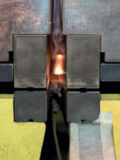
Phase one comprises a temperature and pressure control: The rim blank that has already been bent into cylindrical form is introduced to the welding machine and heated under pressure and regulated electricity input. In the welding phase that follows the two ends of the cylinder form are pressed together using position control, charged with a defined direct current and welded. This is also known as ‘resistance butt welding’, a form of resistance welding.
"We have managed to markedly reduce the expansion of the weld seam and at the same time improve the quality using the new closed loop control," says Michel Leen and adds, "We have been able to cut the energy consumption during welding by about 20 per cent and noticeably reduce the number of rejects."

1:1 implementation of the model thanks to "M-Target for Simulink"
The actual welding process only takes a fraction more than a second. During this process a number of parameters must be recorded and immediately incorporated into the loop. "So we had to look for a control system that allowed extremely short cycle times," says Michel Leen and adds. "With the Bachmann control system we found a system that easily delivers the required performance."
Rapid porting to the real system
"We had simulated the model in Simulink and successfully implemented it in the dSPACE laboratory system," says Michel Leen.
"After that, we had planned 3-4 months for the porting of the Simulink model to IEC 61131 for our previous industrial controlling system," said Mr. Leen explaining the original plan. "So you can imagine our surprise when the Bachmann engineers presented the transfer of our model onto the Bachman control system within a matter of hours using M-Target for Simulink."
However, this solution presented the specialists at Fontijne Grotnes with other advantages besides the huge gain of time. Thanks to the automatic porting, the model could be transferred to the control system without errors and without being simplified, and the respective simulation findings could always immediately be fed back into the system. Because the Simulink target is deeply embedded within the Bachmann control software, the process could be directly monitored and optimized using Simulink during operations. The functionalities of cross communication that are part of the M-Target for Simulink solution made it possible to embed the Simulink solution seamlessly into the conventional automation process (PLC). "That way we were able to cut our time-to-market by at least six months," says Fontijne Grotnes’ Mr. Michel Leen, clearly more than satisfied with the Bachmann solution.


Successful in operation
Meanwhile, the new rim welding system is being tested by one of the leading manufacturers of car wheel rims in Europe. The new system makes the production result significantly more independent of the material used and also from the experience and sensitivity of the operator, who previously had to manually influence the welding process. Thus meaning that Fontijne Grotnes has succeeded in greatly reducing the number of rejects at an output of 1000 rims per hour.
"With the new system we have impressively underscored our pioneering role in rim production machines in keeping with the highest automotive standards," says Michel Leen. "Bachmann made an important contribution to this success with the functionalities of automatic porting of the Simulink results to the control system and the performance of the Bachmann systems."
